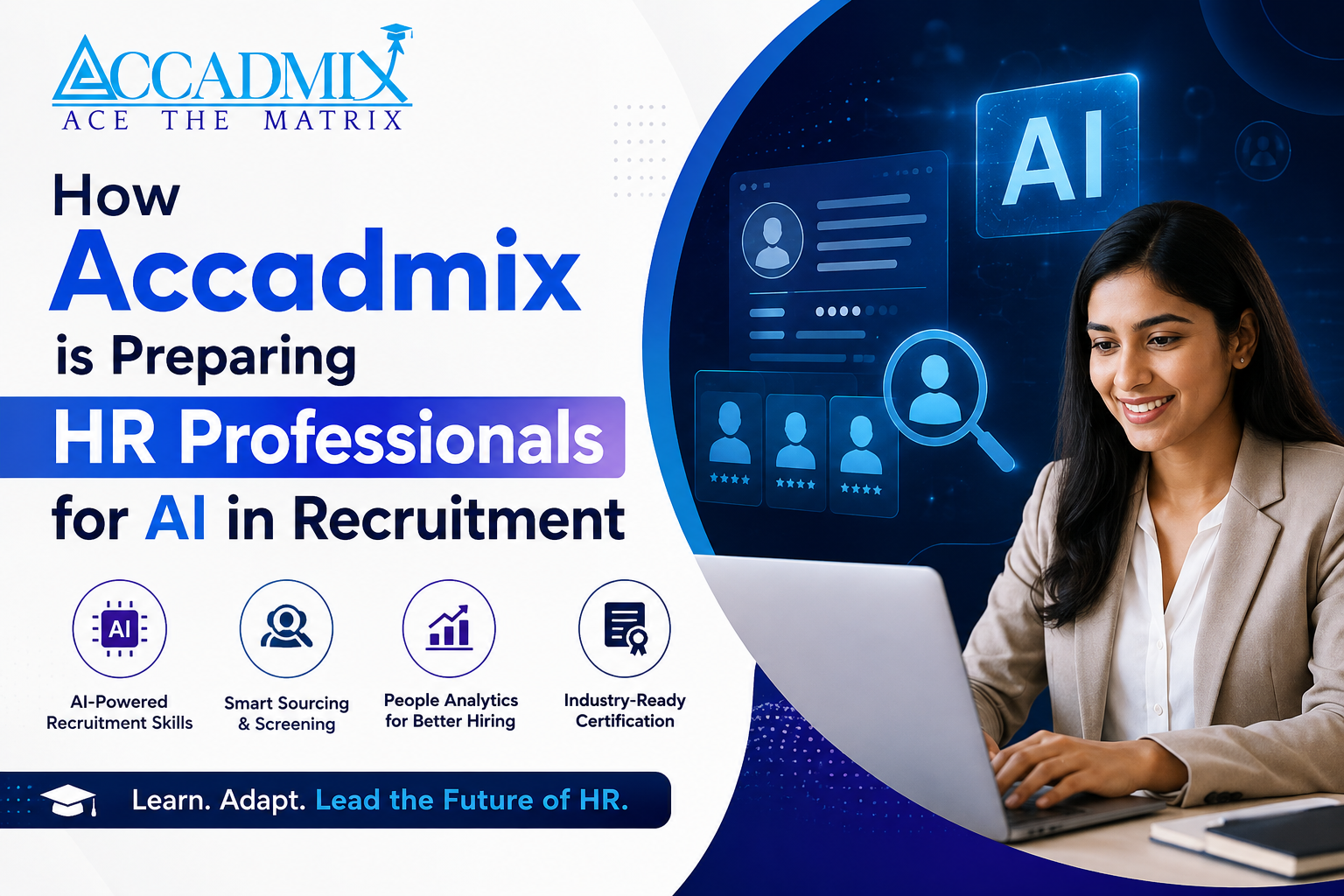
The trends are changing; recruitment is no longer defined by just posting job profiles, screening resumes, and scheduling interviews. AI is transforming how HR‘s are sourcing candidates, evaluating skills, managing applications, and making hiring decisions.
But this is not where the challenge ends. While organisations are adopting AI in recruitment, there is another challenge that awaits: Are HR professionals prepared to work alongside AI?
Just knowing the presence of AI is not enough anymore. Today’s HR professionals need to understand how AI is entering each of their workforces, be it recruitment, automation, preparing reports, collecting employee feedback, payroll, or compliance.
This is where Accadmix bridges the gap. By combining strategic HR knowledge with practical AI exposure, data analytics, and modern HR tech, we prepare professionals to thrive in a recruitment landscape where technology and human expertise work together.
Why AI in Recruitment Is No Longer Optional for HR Teams
Recruitment is now faster, fiercer, and more sophisticated than ever before. The challenge is to source, screen, interview, and onboard candidates in the shortest possible time while maintaining the highest quality of hire.
Human recruiters are overwhelmed with screening hundreds of applicants, engaging with candidates throughout the hiring process, and minimizing the time-to-hire without compromising on the selection quality.
Traditional recruitment methods are not equipped to handle such high-throughput, high-velocity hiring. And when it comes to performing tasks such as screening, interviewing, and follow-up meetings, automation can provide a much-needed boost.
The reality is that artificial intelligence can be leveraged to help human recruiters by shouldering the mundane and repetitive tasks involved in the hiring process.
By taking over the rule-based functions in the recruitment process, AI grants recruiters more time and freedom to focus on the human aspect of the job. And ultimately, that is the key advantage of artificial intelligence in recruitment: to make hiring smarter, faster, and easier—without sacrificing the critical human touch.
While in 2026, AI in recruitment is no longer a novelty but rather a necessary evil, the truth is that for many HR leaders, the ability to leverage AI to gain an edge over competitors is now table stakes. The challenge is that while adopting AI in recruitment is no longer optional, human recruiters need to reskill to be able to use AI effectively.
How AI Is Transforming the Recruitment Process Essay
Using AI can change the recruitment process both qualitatively and quantitatively. In other words, this technology can help get more candidates on board and help communicate with them in a more efficient way. It can also help to streamline the hiring process and make sure that people get better matches for their qualifications and experience.
Perhaps, the most straightforward use of AI in recruitment is resume screening. With this technology, recruiters and employers can analyze hundreds of resumes to find those that fit the necessary requirements the most. Moreover, using AI, one can highlight the most qualified candidates on a resume and sort out the applications according to the needs of the position. It would save the recruiters’ time and effort, which is a severely limited resource during the hiring season.
Another way in which AI is used in recruitment is candidate sourcing. With the newest technologies, one can find candidates that fit the specific requirements best. The recruiters are no longer required to spend hours upon hours searching for the necessary resumes. Instead, they can find the most relevant candidates and then work with them to plan the next steps of recruitment.
Using AI in the recruitment process makes communicating with the candidates more efficient and organized. It becomes possible to send automated messages, set up chats, schedule interviews, and send application letters. Moreover, this approach will help to reduce the time spent on communication and save the recruiters time and effort. At the same time, this strategy can also reduce the risk of rejection due to poor communication, making candidates experience more pleasant.
Overall, it can be asserted that the AI-assisted recruitment process takes away the hard part of communication and screening while leaving the most crucial decisions to people. This process makes sure that candidates are evaluated against the most relevant criteria and helps to match the most suitable candidates to the jobs.
The Skills of Human Resource Professionals that Will Be Necessary With the Use of AI in Recruitment
Nowadays, as the sphere of work of an HR professionals becomes more and more reliant on artificial intelligence, the skills they need to learn go beyond the classic recruitment techniques. They still have the responsibility of managing the hiring process, but having a good understanding of how technology, big data, and AI works, and how they complement and improve traditional ways of recruitment is becoming more and more advantageous for them.
Although a career in recruiting will see a definite shift towards more technology-assisted hiring, it does not mean that every HR professionals needs to become a computer scientist. Rather, they should have a basic understanding of how AI tools need to be used wisely alongside conventional methods.
The skills needed for that include the use of different AI tools for recruitment, understanding the data they produce, recognizing biases, if any, using those insights in tandem with a human resource professional’s expertise, and other soft skills.
While it is crucial for HR professionals to learn how to use new technologies, one should not forget about the importance of human-centered recruitment practices. At the end of the day, machines are only as good as the people who program them.
AI may be able to process thousands of job applications and find potential matches based on specific criteria, but it will not be able to evaluate a candidate’s motives, background, culture fit, and much more. Therefore, the future of recruitment will not be dominated solely by either humans or machines. Instead, the focus will be on those professionals who understand how to use both effectively.
That is why the rising skills gap in the field of human resources, especially when it comes to technological knowledge, is an issue that should be addressed actively. An accessible option for recruiting professionals to gain at least some understanding of the basic concepts of artificial intelligence is to participate in practice-oriented courses.
How Accadmix Is Preparing HR Professionals for AI-Driven Recruitment
Recruitment is witnessing a paradigm shift driven by the rise of artificial intelligence (AI). This means that companies are in dire need of HR pros who can think beyond the established recruitment practices and have a basic understanding of how technology can enhance the process and complement human abilities.
It is precisely this aspect Accadmix concentrates on when preparing professionals for the future of recruitment. By focusing on AI, analytics, and contemporary trends in the field, it covers all the necessary aspects of transformation in human resource management.
It allows the students to learn the potential of technology in different stages of the recruitment process, beginning from attracting candidates to the job opening to analyzing and assessing the talent pool, communicating with prospects, and making informed hiring decisions based on the information available. It equips them with the knowledge of where the use of technology is pertinent and where human expertise is needed.
Apart from that, Accadmix is also concerned with providing learners with a comprehensive understanding of the key areas where modern recruitment is heading. As such, it prepares the students for the kinds of transformations that are bound to happen in their respective organizations.
This includes such areas as AI-driven recruitment practices and software, analytics, automation, and digitalizing the HR functions. These areas will be the central skills that will empower HR professionals to shift from administrative to strategic business partners in talent management and decision-making in the future. Recruitment is changing at a rapid pace, which means the people in the field need to constantly update their knowledge and skill sets.
This way, they will be in a position to comprehend the practical application of technology in the various HR functions and be confident in their ability to handle the new systems and processes.
Why Human Judgment Will Still Matter in AI-Powered Recruitments Essay
While it may seem that with the rise of AI, most if not all aspects of recruitment will be automated, there are still areas that will continue to rely on human judgment. At some point, an applicant who seems to fit the role based on objective criteria may not be right for the team, the company culture, or have other unquantifiable attributes that make them a poor fit for the position. Additionally, there is a need for responsible AI use, wherein recruiters should understand the limitations of the technology and how to use it to complement their decision-making rather than replace it. Finally, the best HR leaders will utilize the advantages of AI while continuing to hone their skills as people leaders.
While there is no doubt that artificial intelligence will lead to faster recruitments and more objective decisions, it will not eliminate the need for human judgments. A candidate may appear to be qualified for a position and checked off all the subjective and objective requirements but may not be the best fit for the role. Some attributes of a candidate, such as their motivations and soft skills, may elude quantification. Meanwhile, their work ethic and attitudes may be detrimental to the workplace environment despite being “hard” skills. AI, therefore, cannot eliminate the need for human judgments in recruitments.
Aside from differences in human judgments and qualities that are difficult to quantify, another reason that AI will not replace human judgments is responsible AI use. Because AI relies on patterns in the data, it can reinforce and amplify the existing biases in the recruitment industry. Human recruiters, therefore, have a responsibility to ensure that the use of AI is not discriminatory or unethical. Understanding the limitations of these technologies will be vital to ensuring that AI-assisted recruitments will be “fair.” Furthermore, recruiters must also determine when to trust and when to question the recommendations of AI systems.
The best HR leaders will be those who can complement AI with their human judgments. To that end, it is vital that HR professionals do not only learn to use AI technologies but also prepare themselves to make decisions about technology use. In other words, they should develop their strategic competencies. This is why preparing for AI in HR is not only about learning how to use new technologies but also about mastering how and when to use them.
What the Future of AI in Recruitment Means for HR Professionals
AI will become a prevalent component of the recruiting process, and HR teams will see a rise in the extent to which they could utilize various technological tools in candidate screening, talent management, recruitment processes, skill assessments, and workforce decision-making. However, the most significant shift will not be in the strategies and operations of the organizations but rather in the expectations of professionals in the field.
With increasingly automated administrative and operational tasks, recruitment advisors and specialists would be expected to focus more on strategic initiatives and the human side of talent acquisition and management. To meet these changing needs, HR professionals would need to constantly update their skill sets and learn new competencies.
While expertise in traditional recruitment practices and procedures will still be necessary, the increased emphasis on automation and artificial intelligence would require specialists to understand various digital tools and approaches. Moreover, human skills will remain indispensable and, therefore, should be learned and reinforced to complement technology and its limitations.
As such, the future of the HR professional is not about learning more AI and robotics but rather about strategically using the most appropriate tools. This consideration will be critical for individuals aspiring to advance their careers in the field as recruiters, hiring officers, and talent specialists since it will allow them to remain at the forefront of an increasingly automated industry while still emphasizing their competitive advantages.
Preparing HR Professionals for an AI-Driven Future
Recruitment is undergoing a change led by artificial intelligence. However, the effectiveness of this trend is solely dependent on how well HR professionals can learn to integrate emerging technologies into their work. The way candidates are sourced, screened, and communicated with, how the recruitment process can be optimized, and how best to use the data insights to inform decision-making—all these processes can be made faster and more efficient with the help of AI-driven solutions. As much as this technology can support many facets of recruitment, it cannot replace the need for learning new ways of doing things.
The future of work dictates that human resource experts should be more skilled and knowledgeable in preparing themselves for a workplace that is increasingly reliant on digital technology.
That is why Accadmix helps to drive innovation in the recruitment process by combining strategic and experiential elements of human resource management with AI, analytics, and modern approaches and tools to prepare learners for the future. It is not about future-proofing them against obsolescence but rather positioning HR professionals to add more value to their organizations through technological competence. The focus of this program is on ensuring that learners are not only familiar with such an environment but are also proficient and productive when using these emerging technologies to perform their duties more efficiently and effectively. One of the main concerns regarding AI in the workplace is that it will eventually eliminate the need for human capital. This is not the case, considering the fact that most aspects of the recruitment process have been reliant on technology even before the advent of this particular wave of technological revolution. These factors are more of a preparatory measure to help these professionals take advantage of a career path that is growing by the day.