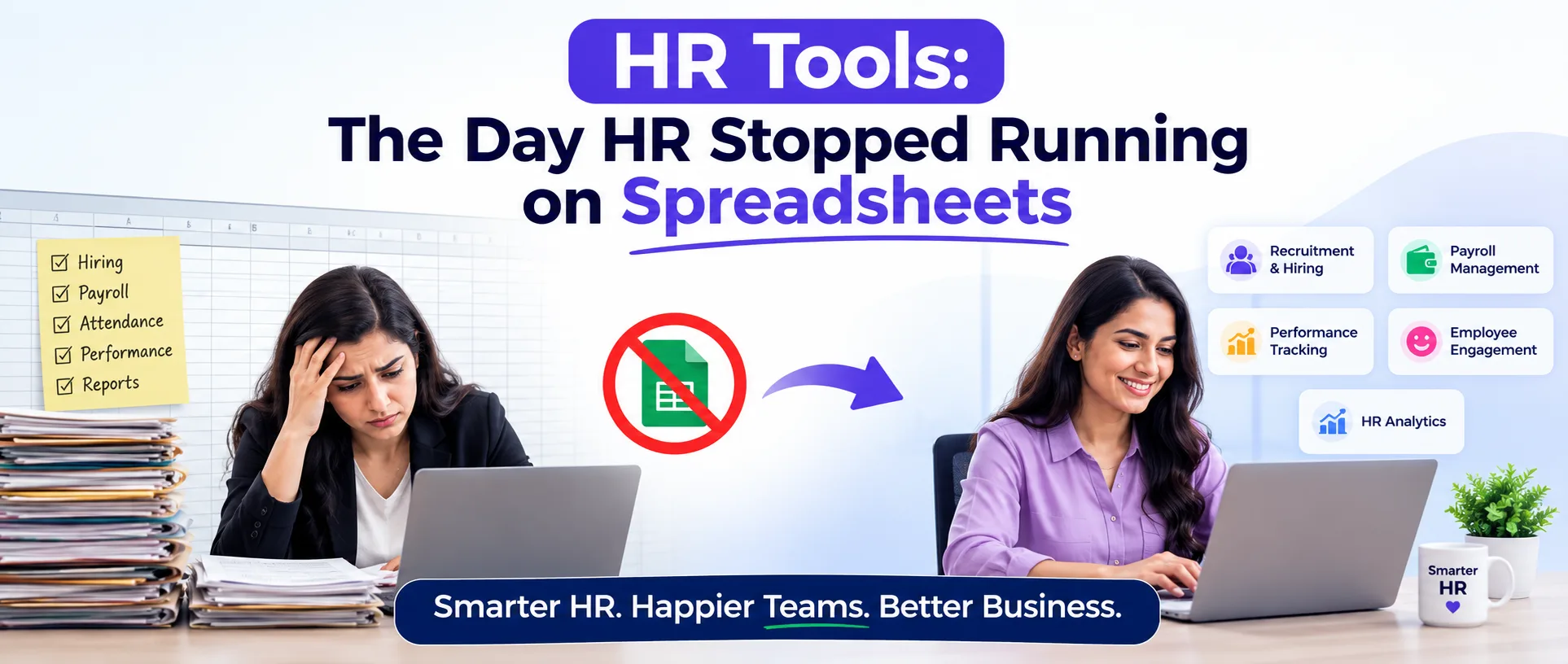
Imagine trying to run a multinational company using sticky notes and Excel sheets. Sounds impossible, right?
Yet many companies and HR teams still rely heavily on spreadsheets simply because they are familiar, easy, and deeply convenient in daily workflows. Over time, using these manual sheets has become more than just a preference; it has turned into an entrenched tradition that organizations struggle to move away from, even when better alternatives exist.
But as they say about tradition, it neither does grow now lets you grow. Spreadsheets are the stereotype that restraints are like an addiction, something that makes you want to go back to again because you find it comfortable. When HR teams spend 80% of their week playing data babysitter by manually updating rows, fixing broken formulas, and chasing down outdated tabs they aren't acting as strategic partners. They're acting as human software patches for a tool that was never built for modern talent operations.
Now, it’s time to stop the manual entries, the patching up of spreadsheets and start building a system that is not only scalable but smart, fast and something that breaks the tradition but preserves the essence. The transition to hr Tools isn't cake walk nor is it about replacing spreadsheets, it’s about replacing friction with efficiency.
HR leaders don’t have to wrestle with broken formulas. Instead, they get a centralized engine built specifically to manage, support, and grow their workforce.
HR Tools: Not the Replacer but the Alleviator
One of the biggest misconceptions surrounding HR technology is that automation replaces human connection. In reality, it does the exact opposite: it clears away administrative clutter so human connection can actually happen.
The time that was being utilized in manually updating spreadsheets or fixing formulas, it is now utilized in growth planning, understanding, and above all laying out plans that not only have an impact but are a straight road to prosper. Modern HR software handles the repetitive routine so people can focus on the relationships.
Here are three modern solutions streamlining the work:
Onboarding made easy by transforming scattered paperwork with a friendly online portal.
Instant & visual data by switching from spreadsheets and complex formulas to instant reports about staff retention, engagement, etc.
Empowering your people through self-service booking leaves and managing personal info. No more follow-up emails
What Exactly Are HR Tools?
Consider HR Tools as Your Digital Teammates.
Forget about manually managing attendance sheets, resumes, payroll details, leave applications, performance reviews, or employee records. These specialized hr tools are designed to address unique HR challenges with tailored solutions. Imagine having an assistant that keeps track of all the essential aspects of human resources without requiring you to do everything manually.
Every HR tool serves a specific purpose.
Let me list them out for clarity.
Some will simplify the process of recruitment.
Some will improve the way you learn. And some will even help measure your employees’ performances. We use AI to provide you with other workforce insights.
HR Tools: The Professional Toolset
Here is what you should know about the HR toolset.
1. Human Resource Information Systems (HRIS)
Applications:
Employee records
Leave management
Attendance management
Employee payroll.
Examples of HRIS:
SAP SuccessFactors
Darwinbox
BambooHR
2. Applicant Tracking Systems (ATS)
Applications:
Resume screening
Publication of job vacancies
Tracking job applicants
Scheduling interviews.
Examples of ATS:
Greenhouse
Lever
Workday recruiting.
3. Performance Management Software
Applications:
Tracking employees' goals
Providing feedback
Reviewing employee performance
Setting up OKRs.
Examples of Performance Management Software:
Lattice
15Five
Culture Amp
4. Learning Management System (LMS)
Applications:
Training employees
Compliance training
Improving the skills of employees
Obtaining certifications.
Examples of LMS:
Moodle
Docebo
Cornerstone.
5. HR Analytics and Dashboard Tools
Applications:
Predictions of turnover rates
Employment metrics analysis
Workforce planning
Measuring employee engagement.
Examples of HR analytics and dashboard tools:
Power BI
Tableau
Visier.
The Promotion That Never Came
At one time or another in the career of most professionals, there comes a point where they begin to doubt themselves.
Despite working long hours, taking on extra responsibilities, and delivering results, every so often they will witness promotions announced and find no mention of their own name. The question arises as to whether hard work is enough.
In the past, many organizations were very focused on perception, but that is gradually changing. Modern HR tools and analytics are giving organizations the possibility to value measurable contribution rather than assumptions. It makes performance, in turn, a more significant factor in making career decisions.
In one instance, the difference between being overlooked or recognized is not working harder but working in a system that measures what matters.
HR Tools: The Reality Check
Benefits
Quick recruitment process
Enhanced worker satisfaction
Less repetitive tasks
Higher levels of compliance
Use of data for decision making
More effective workforce management
Challenges
Cost of implementing the program
Getting the staff to adopt a new program
Protecting sensitive information
Adjusting to the program
Need to integrate with current systems
FAQs
Which HR tools should beginners learn first?
Beginners should start learning these core HR tools:
Spreadsheets: For basic record-keeping, tracing data, and raw calculation, one must be aware of Excel or Google Sheets.
HRIS (Human Resource Information System): In order to manage core employee records, attendance, and leave. One must be aware of platforms like DarwinBox, SAP SuccessFactors, etc.
Reporting and Analytics Tools: Understanding of software to build visual HR dashboards and analyze key workforce metrics.
Do HR professionals need coding to use HR tools?
There is no requirement for HR professionals to possess the ability to code in order to operate the tools used in HR today.
The majority of HR software, including Core HR Systems (HRIS), Applicant Tracking Systems (ATS), Learning Management Systems (LMS), and Performance Management Systems, is created with a non-technical audience in mind.
Are online courses with certification for HR tools worth it?
Yes—provided the online courses with certificate emphasize practical experience with industry-standard software rather than only theoretical concepts. The best online courses with certificate include live projects, hands-on exercises, and exposure to tools that organizations actively use.
Which HR tool is most in demand?
There isn’t a definite answer. HRIS systems, applicant tracking systems, hr analytics panels, and automated HR technologies are all popular, but the ultimate selection relies on the dimensions and demands of the organization.
The Master of HR Tools is The True Master of Future HR
Smarter workplace, better experience.
The world of business anticipates quicker decision-making processes.
Technology makes it easier to do so.
The HR industry's future is less about choosing between people and technology, and more about leveraging the benefits technology provides in order to improve people's experiences.
To be successful in the future, HR-related specialists need to understand how to make use of the available tools today.