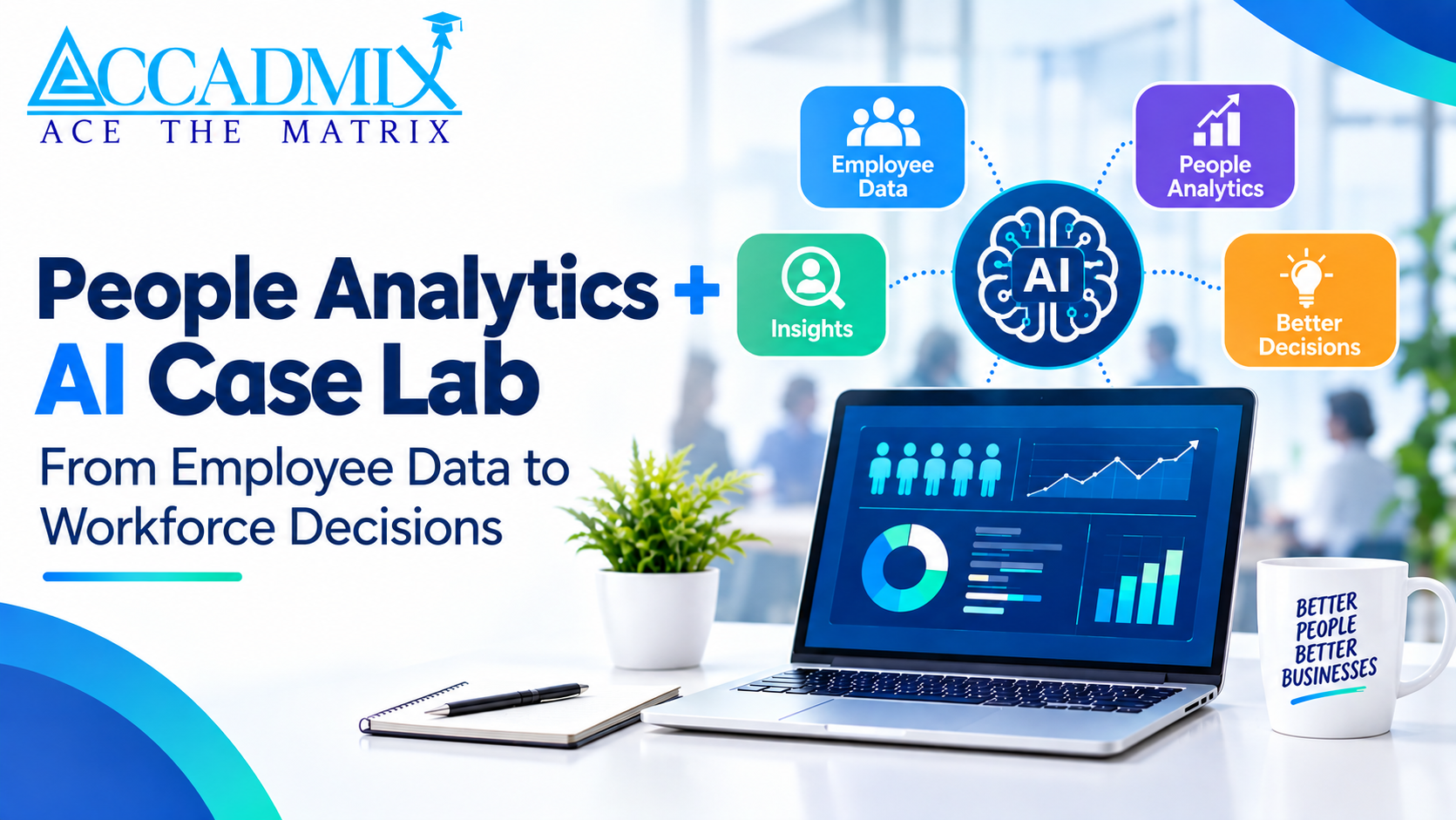
The world of HR no longer follows the traditional approach; experience, intuition, gut feeling or even spreadsheets are no longer the elements that drive HR. Organisations are now adopting AI in HR, the ability to understand and use the workforce data is becoming one of the most important elements of modern HR practice. From identifying employee turnover risks to actually understanding engagement, performance, hiring trends and workforce costs; data is slowly becoming the helping hand for HR teams to make decisions with great accuracy.
This is where People Analytics comes in.
People Analytics is a combination of HR data, analytics and increasingly AI-powered tools to turn workforce information into actionable business perspectives. Instead of just acknowledging the problem, modern People Analytics helps HR professionals to actually understand the root cause of the problem; to understand why it happened, what could happen next and what action the organization should take.
Working HR professionals trying to build a career in a more technology-driven workforce, this is becoming more than just a technical concept they need to crack an interview. Whether a person is exploring the core concepts of the HR profession or are thinking of building a career in HR after graduation or simply looking for a career switch in strategic HR with an AI role, a core understanding of People Analytics can help move from simply managing processes to actually influencing business decisions.
At Accadmix, this is exactly what we prepare you for, building an excelling career with AI in HR with the only HR learning approach we follow: Fundamentals first, AI forwarded always. Helping professionals build HR capabilities with a clear understanding of how AI, analytics and modern HR technology are changing the way modern day HR professionals make decisions.
What Is People Analytics?
People Analytics is the practice of using employee data, HR analytics, technology, and AI to understand workforce patterns and make better people decisions. It not only gathers normal information, it brings together workforce patterns and helps HR to make better decisions from areas such as recruitment, employee performance, engagement attendance, compensation, retention and workforce planning to give HR teams a clear idea of what is happening inside the organization.
Traditional HR reporting focuses on reporting numbers, for instance, how many employees left the company in a particular quarter or how many people the company hired during the same period. People analytics go beyond the numbers. Using AI-driven analyses and predictive modeling, People Analytics helps HR leaders understand attrition drivers, workforce planning, performance trends, and engagement insights.
For instance, with People Analytics, one can go deeper into some vital issues than just attrition rates. Using AI-enabled models, PHR can show which factors are related to employees’ leavers. In this way, PHR helps HR analysts transform from number crunchers into people problem-solvers.
This is the exact shift that makes People Analytics more valuable in the current HR trends. HR professionals who understand how to work with data, AI tools, HR technology and analytics dashboards are the ones who don’t just contribute in administrative processes but they actually work beyond it and become strategic partners to the business.
However, People Analytics is not just about replacing human judgement with AI. It's about helping HR professionals have better evidence to support their judgement providing them and everybody else with better clarity.The real advantage comes when HR expertise and AI-driven insights work together.
Why HR Professionals Need People Analytics
Modern HR tends to become more data-driven. As companies start to embrace AI in people management, HR leaders are expected to go beyond recruitment, employee relations, and generalist expertise, and be able to drive impactful workforce decisions fueled by data and technology. The role is evolving, and professionals need to acquire the right skills to stay relevant and advance their careers in the years ahead.
People Analytics can play a significant role in helping HR professionals achieve such goals.
Using the right HR analytics and AI tools, they can turn employee insights into actions across recruitment, retention, engagement, workforce planning, and people analytics. Moreover, the application of artificial intelligence in people analytics can enable HR professionals to uncover hidden patterns and signals and address issues before they become problems.
This is an important skill for any modern HR professional, including those who are new to people management and want to grow their careers in the field. Whether you are a recruiter learning to use workforce analytics to find the best candidates or an HR business partner seeking to transform employee insights into revenue-growing strategies, such expertise will become a valuable asset in your professional journey.
People analytics and AI are powerful forces in modern people management, and understanding their essence and potential applications can benefit any aspiring HR professional. It can facilitate strategic thinking and enable professionals to maximize the impact of their work, as well as transform their career trajectory. At the same time, the skill will become a necessity for those who want to prepare for the future of work and develop the competencies to lead effective people strategies in the age of disruptive technologies and digital transformation.
The future of HR will be driven by human judgment combined with the smart application of technology. To maximize their chances for career growth and advancement, HR professionals should invest time and effort in understanding the intricacies of people analytics, workforce data, and the role of emerging technologies, including AI, in workforce planning and decision-making. This will allow them to become better business partners and take on more responsibilities as strategic HR partners and transformational leaders in their organizations.
How AI Is Changing People Analytics
AI allows people to turn People Analytics from a reporting practice into something more strategic and predictive. Thus, instead of spending hours collecting and organizing data and creating similar reports, one can take advantage of AI-driven HR tools to gain insight and make decisions faster.
For example, when it comes to employee attrition, traditional HR analytics would only be able to show the rate of employee turnover in a particular period. Meanwhile, with the help of People Analytics and AI, one can go further and investigate why employees were leaving by analyzing the connection between various factors and attrition and find out what is the most common pattern of departure.
Similarly, one can use AI-driven People Analytics in every stage of the employee lifecycle to get valuable insights, ranging from recruitment to retention and workforce planning. One can leverage technology to find trends in the acquired and potential employees, analyze their engagement tendencies, predict future workforce needs, and assess the impact of different initiatives on the business.
Nevertheless, it is essential to note that without proper training and understanding of what questions to ask and which data to collect and analyze, all these technologies and processes would not be beneficial for the company. Thus, there is no doubt that practical exposure to People Analytics, AI, and various other workforce trends is vital for everyone who wants to maximize their skills as an HR professional.
For people, students or even working professionals considering the best HR course online, an HR certification for beginners or an HR course after graduation, the skills and ability to work with AI and People Analytics can be a valuable addition to the normal traditional HR knowledge. The goal is not to learn just another tool, but to actually build up skills to use technology to make better people’s decisions.
What Can HR Teams Measure with People Analytics?
People Analytics becomes valuable when HR teams use workforce data to answer real business questions. With the help of HR analytics, AI-powered tools, and workforce dashboards, organizations can track patterns across almost every stage of the employee lifecycle.
In recruitment, with the help of analytics, it will be possible to determine which channels bring the most quality candidates, how long the vacancy is open, and where candidates are lost. In addition, by analyzing the data, AI will help find patterns and predict the need for employees.
When it comes to employee engagement and retention, the analysis of surveys, attendance, tenure, performance, and other factors helps in building the workforce strategy. Moreover, predictive analytics can identify potential risks and help mitigate possible negative trends. For example, the system will track changes in staff behavior that could indicate an impending resignation.
People Analytics can also be used to evaluate and grade employee performance. By analyzing patterns related to goals, skills, learning and development, and the overall impact on the business, managers will be able to identify high-performing employees and those needing help. This replaces the annual review of each employee with a more data-driven and continuous assessment.
Finally, with the help of analytics, workforce planning and modeling can be carried out. By analyzing key indicators such as staff numbers and skills, turnover rates, productivity, and business growth, the heading of people analytics will be able to plan future hiring and the qualifications needed.
The objective is not to collect on more and more employee data. It is to identify what is actually right, the right data, asking better questions, better analyse the problems and turn all these insights into valuable business insights. That is where People Analytics moves beyond just reports and becomes strategic capabilities for modern HR.
Key People Analytics Skills HR Professionals Need
Learning People Analytics is not limited to the art of being good at Excel or getting better at yet another HR software. Today’s modern HR professional needs the right mix of HR intuition, analytical skills, AI literacy, and business sensibility to be able to derive actionable insights from the ever-growing pool of workforce data.
First and foremost, understanding of people analytics requires a basic comprehension of HR metrics and analysis. After being acquainted with the underlying principles, an aspiring HR professional should be able to assess such metrics as attrition rate, time-to-hire, employee engagement, absenteeism, cost-per-hire, and many others, and understand how they impact different areas of the business.
Next, in the growing stream of discussions about artificial intelligence, people analytics now have to incorporate AI-literate practices. This includes an understanding of how modern recruiting technologies work and what they are capable of, how different AI technologies can be leveraged to optimize and automate certain processes, and what areas still require human expertise.
Finally, building on these basics, an aspiring HR professional should be able to build a C-suite worthy presentation of people analytics findings. Through utilization of different Excel functions, statistical analysis, report generation, and graphical visualization tools, they should be able to convey their discoveries in a way that non-specialists would be able to comprehend and take action on.
Business sense is yet another essential component of analytics that cannot be ignored. The ability to define a business case and approach an issue from a solution-oriented perspective is vital for any HR analyst, as it allows them to connect dots and form viable recommendations.
These combined skills, along with some fundamental HR knowledge, are becoming increasingly sought after in the modern workplace and can provide an aspiring professional with significant advantages in the industry. As such, they should be prioritized when selecting the framework for an HR-focused educational course or shaping individual learning experiences.
How Accadmix Helps Build AI-Ready HR Skills
Learning People Analytics becomes more interesting when you are able to apply it to real workforce problems. This is where Accadmix helps you by taking a practical approach to modern HR learning, whether it is AI, HR Analytics or any other industry relevant tools we combine the HR fundamentals to deliver what is the best.
At Accadmix we don’t treat AI as a standalone technology, we focus on how it can be applied across real HR functions, from recruitment and employee lifecycle management to workforce analytics and decision-making. This helps learners to develop an understanding of how AI powered HR tools, analytics dashboard and workforce data can support everyday HR processes.
The focus here is on the practical application of whatever you learn. Working on real life case studies, real business scenarios and live projects helps the learners to move beyond the traditional method of just understanding the concepts without the practical application. It helps learners to actually interpret data, identify workforce patterns and present actionable recommendations.
For someone evaluating the best HR course in India, best HR course online, or best HR training institute, the quality of practical learning matters as much as the course title. Curriculum, hands-on projects, mentorship, AI exposure, and the ability to apply skills in real workplace situations should all be part of that decision.
At Accadmix, the goal is simple: help HR professionals become more confident with people, data, and AI—so they are prepared for the way HR is actually evolving.
Frequently Asked Questions About People Analytics
What is People Analytics in HR?
People Analytics refers to the way of using employee data, HR Analytics, technology and AI to get insight and make better people decisions. It can be used in recruitment, employee engagement, performance and retention, workforce planning, and many more.
Is People Analytics different from HR Analytics?
Both terms are often used interchangeably but if you want to understand the nuances, People Analytics covers a bigger spectrum and focuses on using people data, combined with HR analytics, AI, and business to make people's decisions.
What skills are required for People Analytics?
An effective people analyst has a blend of knowledge on the basics of HR, analytics, AI, visualisation, and HR technology, along with an in-depth understanding of the workforce and business to make impactful decisions that could help the business achieve its goals.
How do I get started with People Analytics?
Well, you can get started by learning about the basics of HR, followed by Excel and data visualisation, then you can move onto understanding people analytics and AI in HR and finally, start working on projects related to workforce and human data. You can also look for a good HR course that provides you with practical training to master people analytics.
Is People Analytics a good skill to have for an HR career?
Absolutely yes! As companies go more towards data analytics and AI, you need something more than traditional HR skills to get ahead in your HR career. It would help HR professionals to transition from a traditional role to a more strategic and data-centric role. And for people who are new to HR, it would be easier to grasp People Analytics as the core of an HR career.
What should I look for in an HR course that focuses on AI and analytics?
Apart from the cost and HR course duration, you should look for the right HR course syllabus and practical exposure. An effective course should include good training on AI, people analytics, and HR technology and focus on giving the right project and industry exposure to help you succeed in the real world. These pointers can help you compare the best HR course online or the best HR course in India.